
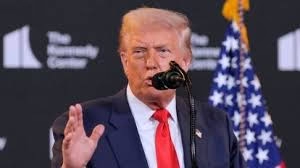
After confirming the capture of Venezuelan President Nicolás Maduro, US President Donald Trump pointed to what he views as the ultimate prize: Venezuela’s vast oil wealth. With American backing, Trump said, the country’s oil industry could be revived to “make a lot of money,” predicting that US companies would repair damaged infrastructure and restore production, according to The New York Times.
Energy experts, however, warn that the reality is far more complex.
World’s largest reserves, tiny output
Venezuela claims over 300 billion barrels of proven oil reserves, the largest in the world. Yet the country currently produces around one million barrels a day, barely 1% of global supply—a steep fall from more than two million barrels a day in the early 2010s.
The collapse has been driven by years of mismanagement, underinvestment, corruption and US sanctions, which have crippled the industry. Complicating matters further, much of Venezuela’s oil is extra-heavy crude, making it costlier, dirtier and harder to refine than lighter grades produced in the US or Middle East.
“These are not easy barrels,” said Richard Bronze, head of geopolitics at Energy Aspects. “Even under ideal conditions, production growth would take time.”
An industry starved of capital
State-run PDVSA suffers from chronic funding shortages and a lack of technical expertise. Oil fields are plagued by aging infrastructure, power outages, equipment theft and limited drilling activity. US sanctions have restricted access to capital, technology and export markets, pushing most Venezuelan oil exports toward China at discounted prices.
While output has inched up in recent years, analysts say the sector remains a shell of its former self.
Chevron’s unique position
One US major has maintained a foothold. Chevron, which has operated in Venezuela since 1923, accounts for about a quarter of the country’s oil production, with roughly half of its output shipped to the US under special licenses.
Following the US operation that removed Maduro, Chevron said its immediate focus was employee safety and legal compliance. Analysts note the company’s long-standing presence could give it an edge if Venezuela opens up to broader US investment—but challenges would remain formidable.
The true cost of revival
Rebuilding Venezuela’s oil industry would require massive investment. Energy Aspects estimates that boosting output by just 500,000 barrels a day would cost around $10 billion and take about two years. Larger increases could demand tens of billions of dollars over a much longer period.
Beyond funding, companies would face political instability, weak institutions and the military’s deep influence over the energy sector.
“There’s a real risk US companies could be pushed into a quasi-governmental role,” said Helima Croft of RBC Capital Markets—helping rebuild not just oil fields, but broader infrastructure and institutions.
Little impact on global oil prices
Despite the geopolitical drama, analysts expect limited impact on global oil prices. Venezuela remains a relatively small producer, and global supply currently exceeds demand. Brent crude has been trading near $61 a barrel, close to yearly lows, and even major upheaval in Venezuela is unlikely to trigger a sharp price spike.
A long, uncertain road
While Trump has framed Venezuela’s oil revival as a near-term opportunity, energy experts see a long and uncertain process ahead. The reserves are real—but turning them into sustained production will require years of stability, enormous capital and political will.
For US oil companies, the central question isn’t whether Venezuela has oil—it clearly does—but whether the risks of rebuilding a shattered industry outweigh the potential rewards.
