
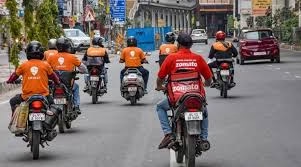
Delivery workers across major food delivery and e-commerce platforms such as Swiggy, Zomato, Zepto, Blinkit, Amazon, and Flipkart have announced an all-India strike on December 25 and December 31, 2025, intensifying pressure on platform companies over deteriorating working conditions in the gig economy.
The nationwide strike has been called by the Telangana Gig and Platform Workers Union (TGPWU) and the Indian Federation of App-Based Transport Workers (IFAT), and is expected to see participation from delivery partners in metropolitan cities as well as major tier-2 urban centres.
In a joint statement, the unions said delivery workers — who play a critical role in last-mile logistics, particularly during festivals and peak demand periods — are facing shrinking earnings, extended and unpredictable working hours, unsafe delivery expectations, arbitrary account suspensions, and a lack of basic welfare and social security protections.
Key demands include transparent and fair pay structures aligned with actual working hours and operating costs, withdrawal of ultra-fast delivery models such as 10-minute deliveries that workers say compromise safety, an end to ID blocking without due process, better accident insurance coverage, provision of safety equipment, assured work allocation, and mandatory rest breaks.
The unions have also called for stronger grievance redressal mechanisms within apps to address routing errors and payment issues, as well as long-term job security measures such as health insurance, accident coverage, and pension benefits.
The statement highlighted what it described as “unchecked algorithmic control” by platform companies, arguing that tightening delivery timelines and fluctuating incentive structures have shifted operational risks onto workers.
Calling for urgent government intervention, the unions urged both the Centre and state governments to regulate platform-based companies, enforce labour protections, implement comprehensive social security frameworks for gig and platform workers, and formally recognise their right to organise and engage in collective bargaining.
“Delivery workers are being pushed to their limits by unsafe work models, declining incomes, and the complete absence of social protection. This strike is a collective demand for dignity, accountability, and justice,” said Shaik Salauddin, founder president of TGPWU and co-founder and national general secretary of IFAT.
The strike comes amid recent labour reforms aimed at formally recognising gig and platform workers. Under the revised Code on Social Security, which came into force on November 21, 2025, digital platforms and aggregators are required to contribute 1–2% of their annual turnover — capped at 5% of payments made to workers — to a dedicated Social Security Fund.
According to the Press Information Bureau, the fund will be used to finance welfare schemes including health coverage, accident insurance, and maternity benefits. The framework also introduces Aadhaar-linked universal account numbers to ensure portability of benefits and expands the legal definition of gig and platform workers.
While several platform companies have welcomed the reforms, saying they provide regulatory clarity and strengthen social security coverage, labour unions argue that the measures are only an initial step and do not adequately address deeper concerns around minimum earnings, workplace safety, and algorithm-driven management practices.
